
Momoh
"I have made it far."

Ten students hop off their kekehs and motorbikes each morning on the bumpy road in front of the National Rehabilitation Center (NRC). They proceed up a covered path to the conference room – a makeshift classroom with a lopsided projector, faded floral curtains, and wobbly wooden chairs – readying themselves for their daily lessons.
Momoh Koneh sits in the front, the first seat to the left when one enters. He leans in close to the screen of his MIT-issued laptop, listening attentively to the speaker – a P&O instructor from India – occasionally tapping a classmate’s shoulder for help with a discussion question. Momoh had never touched a computer before starting the program five months ago. Now, he knows how to type and can submit assignments largely unassisted, something that the 46-year-old considers a great improvement.
His crutches rest on the wall behind him, always within arm’s reach for the first call from work. The second oldest student in the cohort, he spends most of his free time in the NRC workshop, where he has worked as a technician for the past 24 years. As his younger classmates chit-chat on the veranda after class, Momoh meticulously hems the leather exterior of a patient’s prosthesis, pulling screwdrivers and Allen keys out from a personal toolbox that he keeps stashed in the back of the workshop.
For Momoh, this was not just a job, but a work of passion. He told me once that “for people like [me], education was impossible… so I had to rely on my hands.”
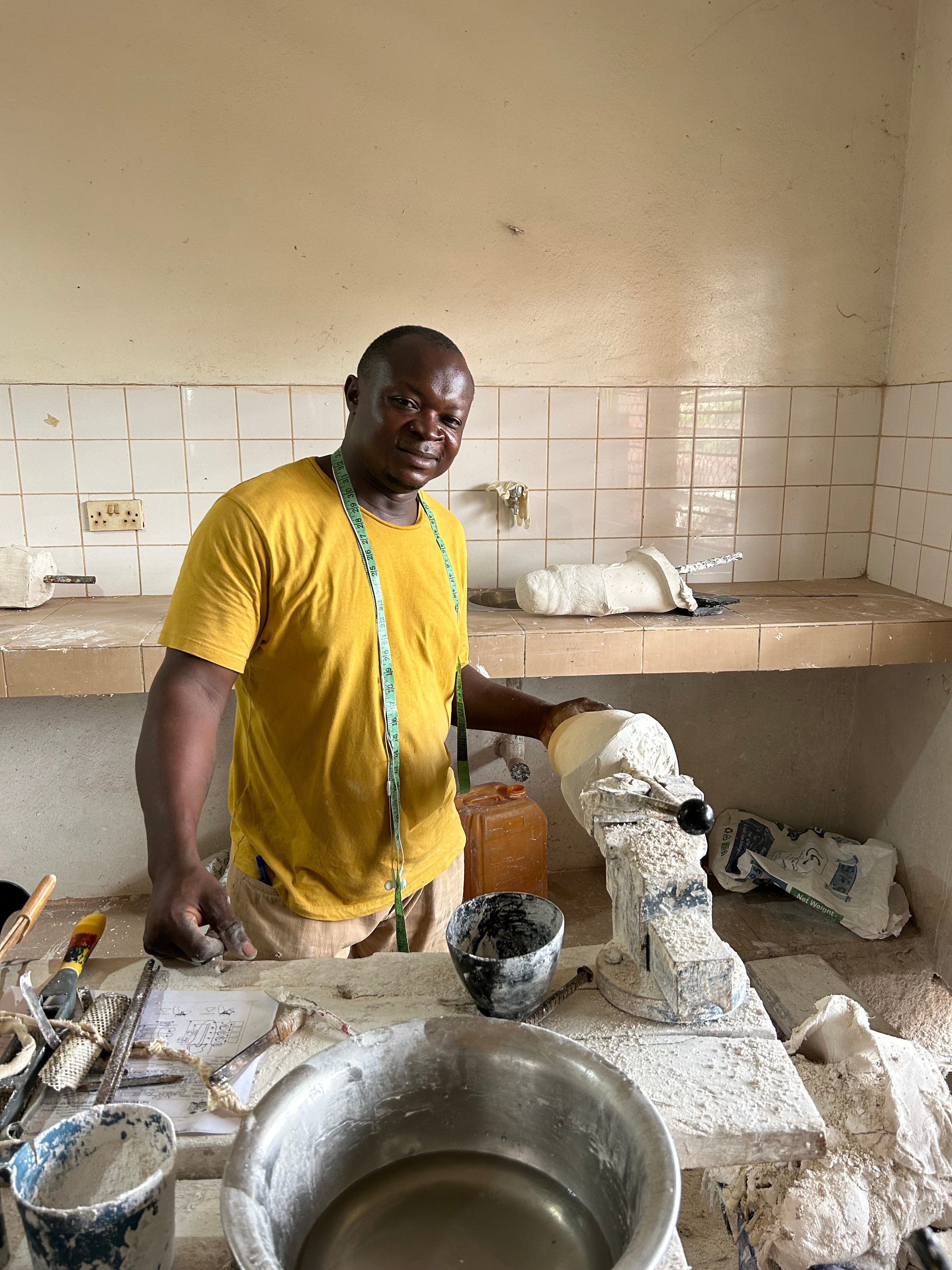
Momoh came from a village near Kenema, a city in the eastern part of Sierra Leone. One of seven children, he was afflicted with polio at the age of three, in what he described as a high fever that took away his ability to stand on both feet. He has been reliant on crutches since, learning to navigate the clutter of each workshop he’s called home (and the often poorly paved roads leading to them).
Growing up as a disabled child in Sierra Leone was not easy, and this was especially the case in the 70s.
“They will humiliate your mother, say things like she’s a witch, and that’s why she gave [my legs] as a sacrifice…” He told me once over the plaster molding station, shrugging his shoulders.
Pressured by the family’s meager income and intense social stigma, Momoh’s mother gave him away to a neighboring village, where he was raised by a kind-hearted neighbor. There, he attended primary school and worked under a local blacksmith, acquiring many of the skills that would benefit him in the clinic today. He would not return to his family until he was fourteen. By then, civil war had broken out in Sierra Leone, putting an indefinite hold on his education. He described being displaced from village to village, sometimes having to walk for up to 45 miles to find the nearest location of safety. Child soldiers were common during the war, but the rebels took pity on his condition and left him alone. Eventually, he ended up at an adult education center and found a job working at Handicap International, the organization that would build the NRC in the late 90s.
Momoh has been in Freetown since, becoming a jack-of-all-trades in the P&O workshop. I first met him while he was in the middle of making correctional braces for club foot patients. He fabricates all of the clinic’s supply, with each batch taking about two weeks to complete. The finished products line up neatly on the bench, ready to be fitted onto the daily stream of children at the club foot clinic in the building across. I’ve since watched him tinker with countless plaster molds and wooden legs, handling repairs with a resourcefulness that puts my MIT makerspace days to shame. The clinicians tell me he can copy any key, just give him the lock – an assertion that I have yet to test.
“My family is proud of me. I have made it far.”
He tells me that he was the first person in his family to live in a city. He now has three children in Freetown, including a daughter studying nursing who he sometimes calls for help on homework. When I asked if he had any plans for the future, after the program, he emphasized his desire for further education, once he has some “quiet time.”
“For me personally, if I focus on it, I believe I can improve myself.”
And I believed him as well, watching him tinker away at the plaster shell of a transtibial prosthesis, never missing a day in the workshop or classroom. Momoh possessed a sort of determination and optimism that fuels our motivation to make the project here at the clinic a success – for the people who simply show up and try, amidst power outages, leaky roofs, and the next crisis-of-the-day.
As we finished our conversation, I asked if he had anything else to share.
“Just… you know, it’s really difficult being a disabled person in a country like Sierra Leone. And the only thing I can say for now is that it’s getting better, really, there is a lot of awareness now. I believe there’s been a lot of improvement… so the kids today, their stories cannot be mine. I hope that as time goes on, it will be much better than this.”
An incredible story, incredibly told!